


Top Down Demolition
Top Down Demolition of Multi-Storey Structures
Floor-by-floor robotic deconstruction — from the roof down, with stability controlled at every stage.
Delivered with remote-operated Brokk and Husqvarna machines on live city-centre sites.
- Floor-by-floor, controlled sequence
- Operators kept out of the drop zone
- No hand-arm vibration exposure
- Facade retention schemes
Peck, cut, clear, repeat
Taking a building down the way it went up — in reverse.
Top-down demolition removes a structure one level at a time from the roof downwards. Where a building sits tight to its neighbours, over a live street or inside a retained facade, it is often the only workable approach.
Used when:
- The site is too tight for high-reach demolition plant
- Neighbouring buildings, roads or the public must be protected
- The facade is being kept while the interior is rebuilt
- New construction needs to start on lower floors as soon as possible
How we deliver it
Robots on every floor. Clearance running alongside.
Break
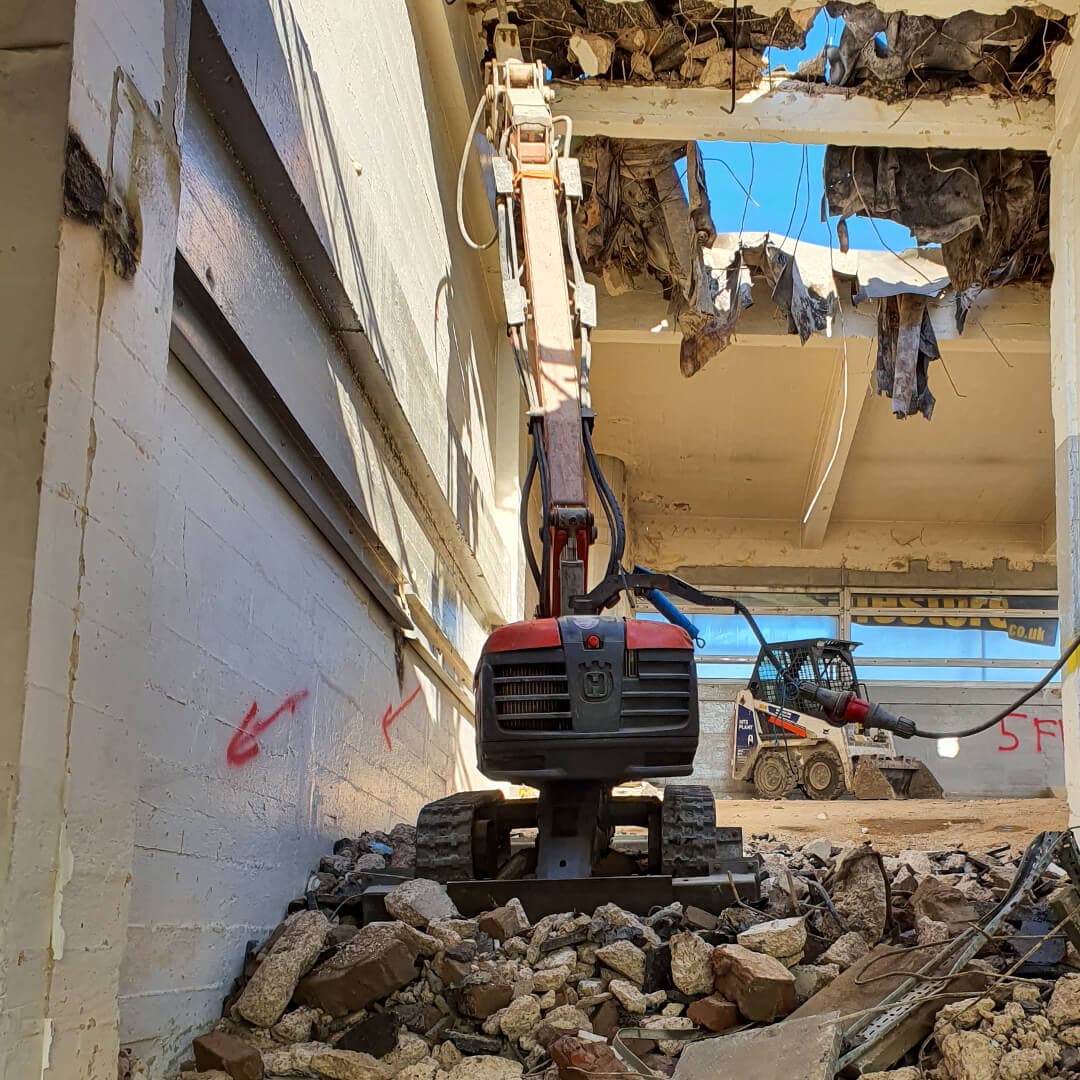
Remote-operated robots break out walls and floor slabs with hydraulic breakers.
Cut
Steel shears crop reinforcement, beams and services as each level is opened up.
Clear
Compact loaders work alongside, removing concrete and rebar so the workflow never stalls.
Repeat
Once a level is clear, the team moves down — the sequence repeats floor by floor.
Stability first
The sequence is designed before the first floor comes out.
Load-bearing walls are identified before work starts and kept in place until they are redundant. The removal sequence and clearance routes are set out in the method statement and RAMS — not worked out on the day.
- Load paths and retained elements identified up-front
- Floor-by-floor removal sequence defined and validated
- Clearance running alongside so debris never builds up
- Exclusion zones and remote operation keep people out of harm
Facade retention
Keep the face of the building. Rebuild what's behind it.
Facade retention paired with top-down deconstruction preserves a building's architectural and heritage value while its interior is removed and rebuilt for a new use.
- Preserves historic or architectural character
- Contains noise, dust and debris behind the retained walls
- Less waste and new material than full demolition and rebuild
- Allows construction on lower levels while upper floors come out
Case studies
Top-down demolition on site.
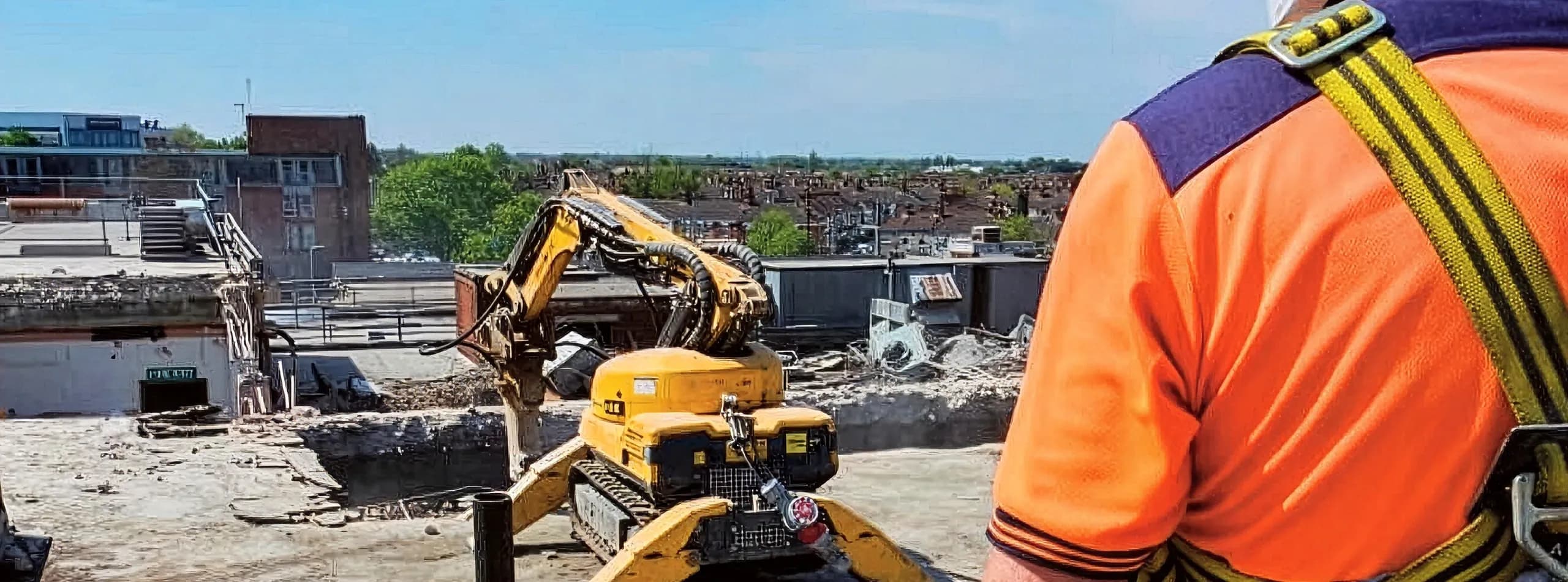
Top-Down Robotic Demolition of a 19-Storey Leeds Tower
Husqvarna and Brokk robots deconstructed a 19-storey Leeds city centre tower from the top down, working alongside Bobcats to clear concrete and rebar.
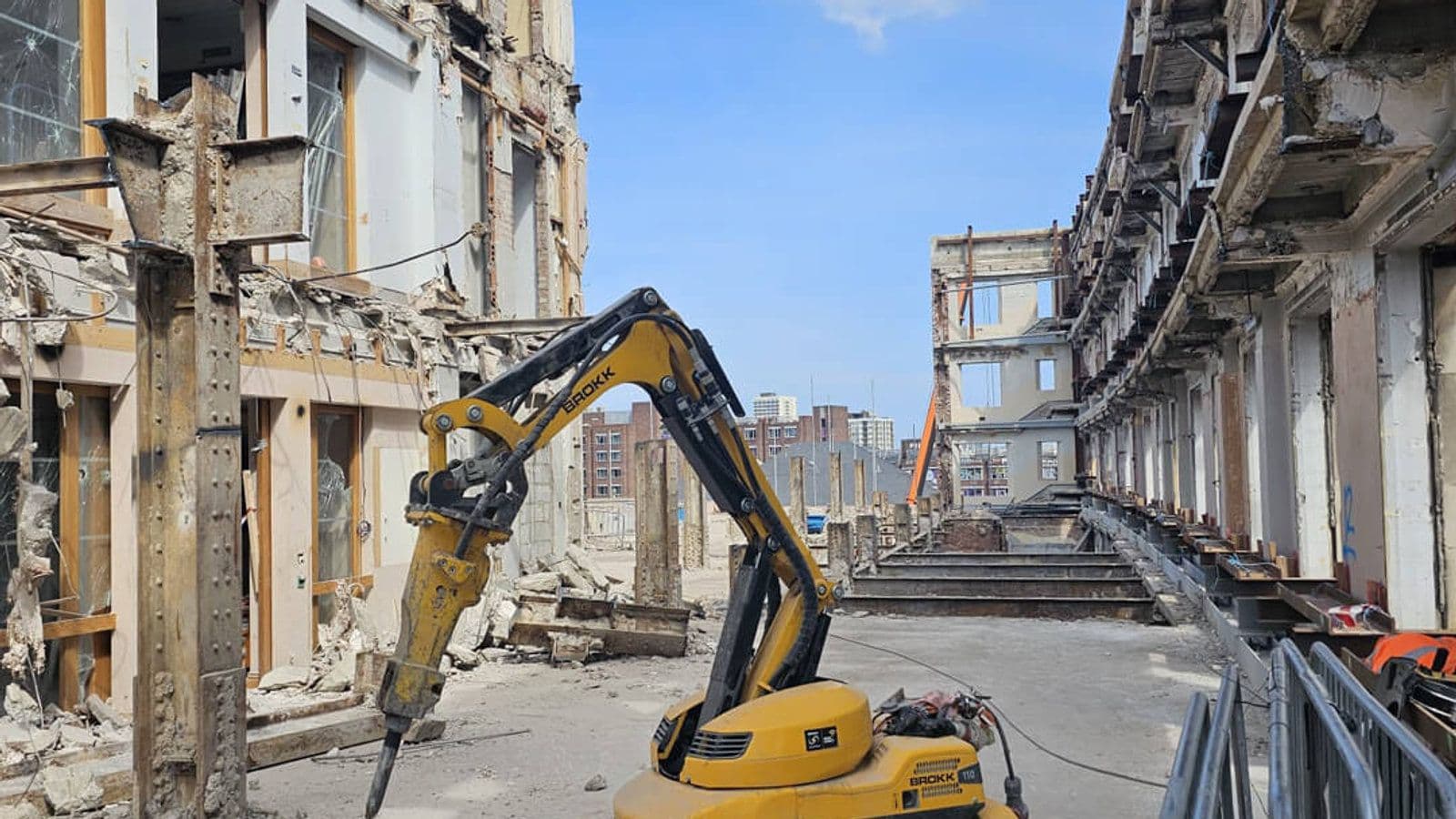
Large-Scale Facade Retention with Top-Down Deconstruction
Facade retention paired with top-down robotic deconstruction preserves architectural heritage while enabling fast, low-disruption interior rebuilds.
The machines
Matched to the floor loading and the structure.
Machine size is chosen around what each floor can carry and how thick the structure is. Compact Brokk models work on upper floors where loading is limited; larger machines take on the heavier lower levels and foundations.
See it in action
Browse robotic demolition projects in the gallery
Where this method anchors
Industries served by this discipline.
Each linked hub explains the sector — the constraints, the case studies and the way method definition adapts to that industry's regulatory and operational regime.
Industry hub
Process & Refractory
Confined-space robotic work inside kilns, furnaces and process vessels — controlled contaminant handling, operator-safe remote operation.
Sector page →
Industry hub
Petrochemical & COMAH
Petrochemical, oil & gas, refining — spark-free, ATEX-compliant methods built around DSEAR and major-hazard safety regimes.
Sector page →
Industry hub
Heritage & Listed Buildings
Grade I, Grade II and Grade II* schemes where the original fabric must survive while non-original elements come out cleanly.
Sector page →
Industry hub
Water Infrastructure
Treatment plants, reservoirs, sewer flumes, bridge decks and dockside structures — delivered without taking the asset offline.
Sector page →
FAQ
Top down demolition — common questions.
Taking a structure down from the roof, one floor at a time, rather than bringing it down from the base. Each level is broken out and cleared before work moves to the floor below, so the remaining structure stays stable throughout.
Remote-operated machines are light enough to work on upper floors, break walls and slabs with hydraulic breakers, and cut steel with shears — while the operator stays clear of the working area. There is no hand-arm vibration exposure from manual breaking.
Load-bearing walls are identified before demolition starts and kept in place until they are no longer needed. The removal sequence is defined in the method statement and followed floor by floor.
Yes. Facade retention is often paired with top-down deconstruction: the external walls stay in place while the interior structure is removed and rebuilt. It preserves the building’s appearance and keeps noise, dust and debris contained.
On suitable schemes, yes. Because demolition works downwards, new work can begin on lower levels while upper floors are still being removed — shortening the overall programme.
Integrated with specialist demolition methods
Methods are combined, not bolted on — selected based on the scheme's constraints.
Robotic Demolition
Remote-operated machines for confined-access, structural-removal, and high-risk environments.
Hydrodemolition
Non-percussive concrete removal — preserving structure and eliminating vibration.
Diamond Drilling
Precision cutting in reinforced concrete and structural elements.
Cold Cutting
Spark-free cutting for volatile and safety-critical environments.
Planning a top-down scheme?
Send us the drawings and the constraints. We'll set out the sequence, the machines and the clearance plan before anything comes down.