


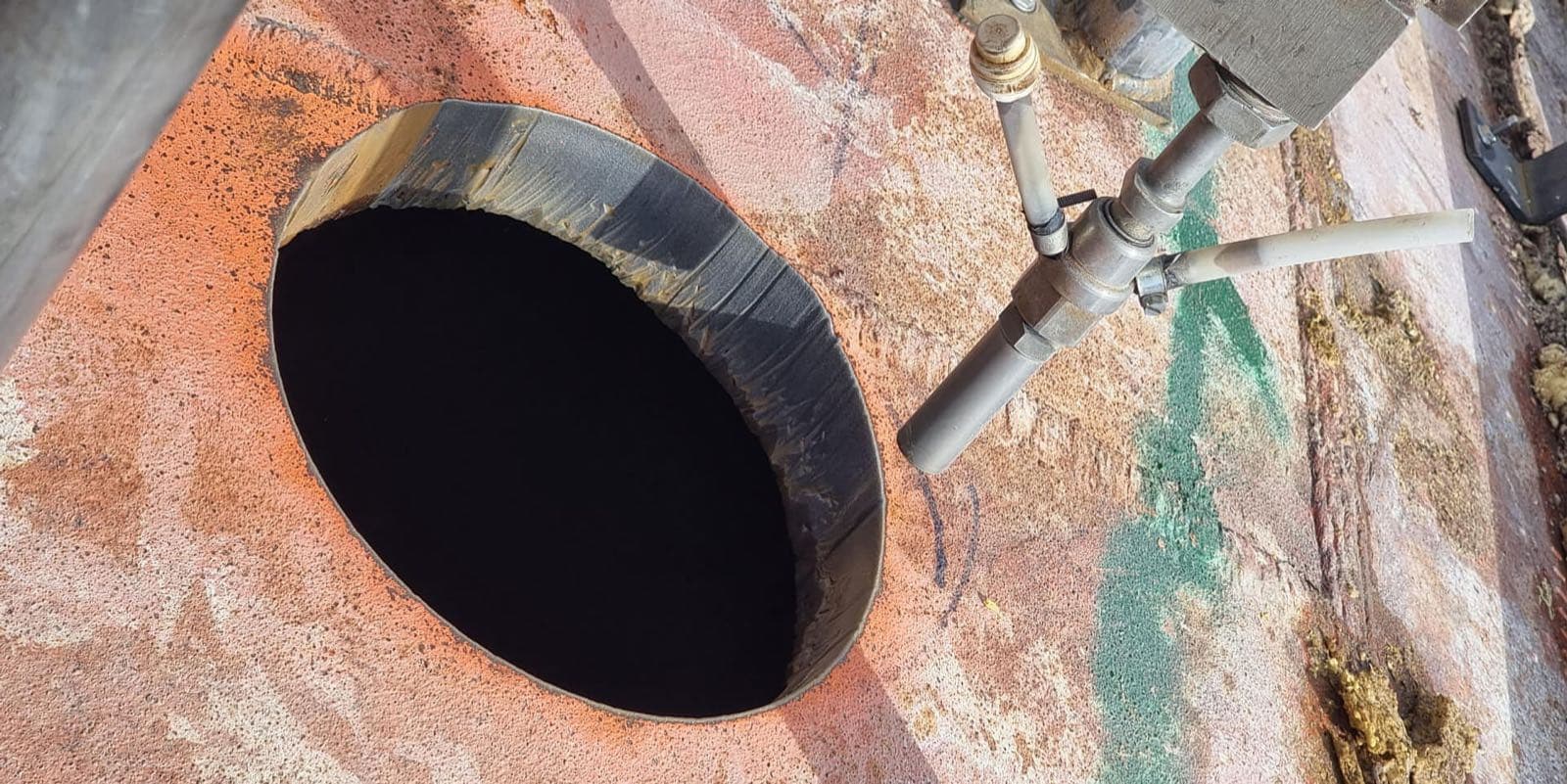
Abrasive Cold Cutting
Abrasive Cold Cutting for Controlled Industrial Isolation
Spark-free cutting of steel, pipework and vessels in live, hazardous or volatile environments — delivered with precision, control and minimal disruption.
- Spark-free cutting in hazardous zones
- No heat affected zone (no distortion)
- Controlled, precise material removal
- Safe isolation of live systems
Cold by design
Cold cutting without heat, sparks or risk.
Abrasive cold cutting uses high-pressure water mixed with abrasive media to cut through steel, pipework and structural components — without heat, sparks or vibration. Primary applications include petrochemical, COMAH and live processing facilities.
Built for hazardous environments
Designed for live and high-risk environments.
Enables cutting and access without introducing ignition risk or structural disturbance.
- Petrochemical and COMAH sites
- Refineries and chemical processing plants
- Live pipelines and pressurised systems
- Storage tanks and pressure vessels
- Confined or restricted access environments
Application range
Controlled access, isolation and removal.
- Pipework and pipeline cutting
- Pressure vessel access openings
- Tank and containment entry cuts
- Structural steel sectioning
- Controlled removal of redundant plant
Integrated method
Part of a controlled demolition system.
Cold cutting is rarely used in isolation. It opens up the next step — and we plan it that way.
Cut access → robotic removal
Spark-free access cuts that allow robotic demolition to work safely inside vessels and structures.
Cut isolation → hydrodemolition
Isolation cuts that release sections for non-percussive hydrodemolition or structural modification.
Section steel → lift / drill
Controlled steel sectioning that enables lifting, removal or follow-on diamond drilling and sawing.
This is where GNAT differs — methods are combined, not bolted on.
Why cold cutting
Why abrasive cold cutting.
- Eliminates hot works risk
- No sparks, flames or heat distortion
- High precision cutting in sensitive environments
- Suitable for live, operational sites
- Reduces shutdown requirements
See it in action
Browse cold cutting projects in the gallery
Where we work
Cold cutting, mobilised from three UK bases.
Abrasive cold-cutting teams deploy from our Yorkshire, Midlands and Hertfordshire bases — covering COMAH-regulated petrochemical sites, offshore decommissioning projects, refinery shutdowns and water-treatment plant nationwide. Spark-free isolation in volatile and ATEX-zoned environments delivered with full DSEAR documentation.
Where this method anchors
Industries served by this discipline.
Each linked hub explains the sector — the constraints, the case studies and the way method definition adapts to that industry's regulatory and operational regime.
Industry hub
Petrochemical & COMAH
Petrochemical, oil & gas, refining — spark-free, ATEX-compliant methods built around DSEAR and major-hazard safety regimes.
Sector page →
Industry hub
Process & Refractory
Confined-space robotic work inside kilns, furnaces and process vessels — controlled contaminant handling, operator-safe remote operation.
Sector page →
Industry hub
Offshore & Marine
Coastal jetties, dockside structures, offshore decommissioning and tidal working — methods that deliver inside marine and weather constraints.
Sector page →
FAQ
Cold cutting — common questions.
Cold cutting removes the ignition source. In COMAH, petrochemical and live processing environments, hot works are either not permitted or carry significant isolation overhead. Abrasive cold cutting allows access, sectioning and isolation cuts to be made without sparks, flame or heat distortion — often without a full plant shutdown.
Abrasive cold cutting is suitable for hazardous-area work where hot works are restricted or prohibited. Each scheme is assessed against the specific zoning, isolation status and site permit regime — not against a generic claim — and the method is defined to match.
Carbon steel, stainless steel, alloy pipework, structural steel, pressure vessels, tanks and clad assemblies. Wall thickness and geometry drive the cutting parameters; material is rarely the limit.
No — that is the point. The cut is made by abrasive media in a high-pressure water stream, so there is no heat-affected zone, no distortion and no metallurgical change either side of the kerf. Material remains in the condition it was supplied.
Cuts on live or pressurised systems are assessed individually against the isolation status, residual energy and site procedure. We will define what is and is not appropriate up-front, including any depressurisation, drain-down or process-side conditions required before the cut is made.
Integrated with specialist demolition methods
Methods are combined, not bolted on — selected based on the scheme's constraints.
Robotic Demolition
Remote-operated machines for confined-access, structural-removal, and high-risk environments.
Hydrodemolition
Non-percussive concrete removal — preserving structure and eliminating vibration.
Diamond Drilling
Precision cutting in reinforced concrete and structural elements.
Machine Hire
Robotic demolition fleet supplied with method-led expertise — not just machines.
Need a safe cutting method for a live or hazardous environment?
Abrasive cold cutting provides controlled access without introducing risk.